


By opting in you agree to receive emails from us and our affiliates. Your information is secure and your privacy is protected.
Stock
12-01-2026 11:31
1 Views
Why Trump’s Tariffs Could Hurt Bitcoin Price, Even If They’re Lifted
Key Takeaways:
- Bitcoin price is holding above $84,000, but confidence remains fragile and the market is still divided on the next move.
- Geopolitical risks and legal uncertainty around Trump’s tariffs continue to weigh on sentiment and could increase volatility.
- Bitcoin is trading in a narrow range between $84,000 and $94,000, with no clear trend yet.
- Some analysts expect neither a sharp rally nor a deep crash, pointing instead to a period of sideways price action.
Despite some of the more bearish forecasts, Bitcoin price is still holding above the $84,000 level. For now, that has brought a bit of cautious optimism back into the market. Some investors believe a move toward $100,000 is still possible if BTC can hold its current range.
That said, fear still dominates. Confidence remains fragile. Many investors are clearly hesitant to believe Bitcoin can return to its previous highs anytime soon.
Bitcoin has now settled into a new price range. Trading looks more like ping-pong between $84,000 and $94,000. So far in 2026, BTC hasn’t revisited the lower end of that range. But these gains remain thin, and geopolitical risks could quickly undo them.
The first weeks of 2026 have been noisy for global markets. Tensions between the US and Venezuela added uncertainty. At the same time, Donald Trump has threatened new actions against Mexican cartels and repeated claims that Greenland should belong to the United States. Trump’s tariff plans are also back in focus. All of this creates an uneasy backdrop for Bitcoin and other risk assets.
For now, the situation in Venezuela has not led to a clear “black swan” reaction in the market. Bitcoin has stayed inside its range. The open question now is whether this reflects resilience — or simply a delayed reaction that hasn’t shown up yet.
Trump Tariffs Hang Over Bitcoin
Geopolitics has partly shifted attention away from Trump’s tariffs. Still, they remain an important factor for the market.
On Jan. 9, the US Supreme Court was expected to rule on whether the president had the authority to impose tariffs on such a large scale. That decision did not happen. The next window for releasing rulings is expected on Jan. 14. Even then, there is no guarantee that this case will be addressed.
This means the situation could drag on for some time.
Against the backdrop of broader global tensions, this only adds more uncertainty and volatility. Markets are left without clarity at a sensitive moment.
If the US Supreme Court rules that the president did not have the authority to impose these tariffs, their legal basis would immediately be called into question.
This is where the situation becomes especially delicate. Companies could start filing lawsuits, seeking refunds worth tens or even hundreds of billions of dollars. That said, this would not necessarily mean tariffs disappear for good. The administration could try to reintroduce them through alternative legal paths.
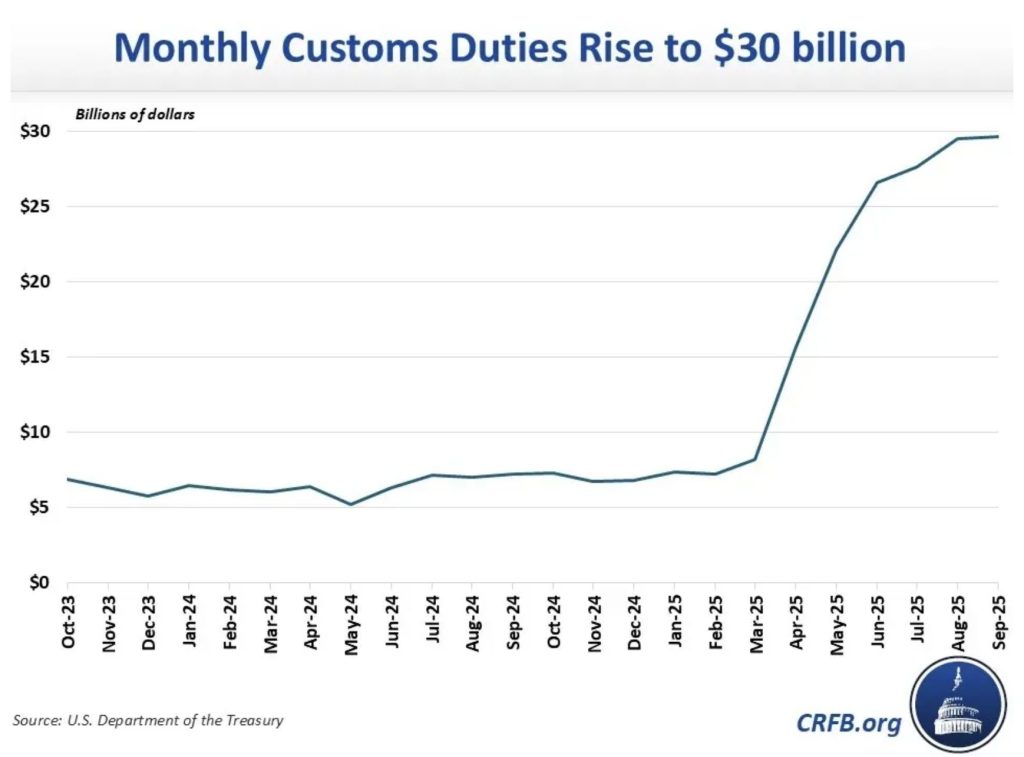
According to official data, tariffs have become a meaningful source of budget revenue. These figures should be treated with caution. After the government shutdown, there are doubts about how reliable the data is. In 2025, tariffs reportedly brought in around $195 billion. That is more than 2.5 times higher than the year before. Budget office estimates suggest that, in their current form, tariffs could reduce the deficit by nearly $3 trillion by 2035.
However, if the Supreme Court rules that many of these tariffs were imposed unlawfully, this revenue stream could shrink sharply.
This is where the paradox appears.
A rollback of tariffs, which many investors are hoping for, could be just as negative for Bitcoin as their continuation. Removing tariffs could trigger sudden stress and volatility. In that scenario, already-weak buyers may struggle to defend key price levels.
Should Investors Expect a Sharp Bitcoin Price Crash?
Views on Bitcoin’s next move are split almost evenly.
Some believe the market simply needs time to digest the recent correction. In this scenario, Bitcoin price could eventually push toward a new all-time high. Others take a much more pessimistic view and expect Bitcoin to fall to $40,000 or even lower. The question is where the balance lies.
Ki Young Ju, founder of CryptoQuant, believes the more likely outcome is neither a sharp rally nor a deep crash. Instead, he expects what he describes as “just boring sideways for the next few months.”
In his view, Bitcoin is unlikely to see a deep correction similar to previous cycles. One reason is that capital inflows into Bitcoin have slowed. At the same time, liquidity has become more fragmented. Attention has shifted toward other assets, including precious metals, amid global political instability:
Capital inflows into Bitcoin have dried up. Liquidity channels are more diverse now, so timing inflows is pointless. Institutions holding long-term killed the old whale-retail sell cycle. MSTR won’t dump any significant chunk of their 673k BTC. Money just rotated to stocks and shiny rocks. I don’t think we’ll see a -50%+ crash from ATH like past bear markets. Just boring sideways for the next few months.
At the same time, reports suggest that large holders continue to accumulate Bitcoin. This includes US-based banks. There are no clear signs of capitulation yet. But there is also little evidence of strong buying pressure. It is possible that Bitcoin’s market cycles are changing. We may only realize this in hindsight. For now, what does seem clear is that the old playbook is no longer working the way it used to.
Disclaimer: Crypto is a high-risk asset class. This article is provided for informational purposes and does not constitute investment advice. You could lose all of your capital.
The post Why Trump’s Tariffs Could Hurt Bitcoin Price, Even If They’re Lifted appeared first on Cryptonews.
Other news